Map

[TOC]

Map特性

键值对
不继承Collection
键唯一

Map方法
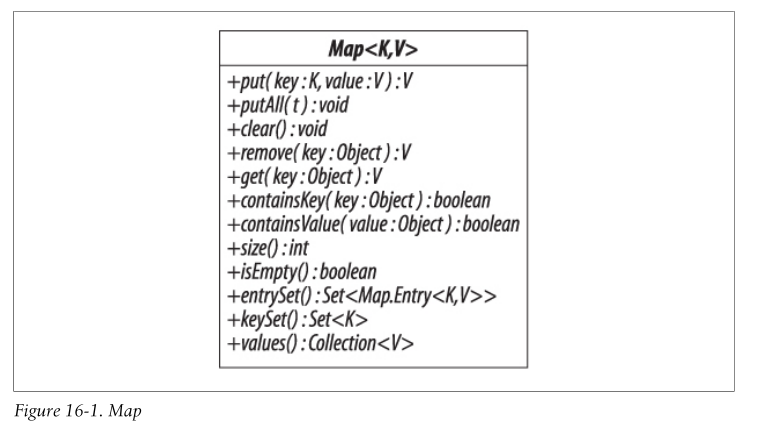
Map.png

添加联系

1
2
3
4
5
6
7
V put(K key, V value) // add or replace a key-value association
// return the old value (may be null) if the
// key was present; otherwise returns null
void putAll(Map<? extends K,? extends V> m)
// add each of the key-value associations in
// the supplied map into the receiver
default V putIfAbsent(K key, V value)//若key对应的value存在,返回;若不存在,设置为给定的值(1.8)

移除联系

1
2
3
4
5
void clear() // remove all associations from this map
V remove(Object key) // remove the association, if any, with the
// given key; returns the value with which it
// was associated, or null
default boolean remove(Object key, Object value) //若key关联的value等于给定的值,则移除这个元素

查询Map内容

1
2
3
4
5
6
7
8
V get(Object k) // return the value corresponding to k, or
// null if k is not present as a key
boolean containsKey(Object k) // return true if k is present as a key
boolean containsValue(Object v) // return true if v is present as a value
int size() // return the number of associations
boolean isEmpty() // return true if there are no associations
default V getOrDefault(Object key, V defaultValue)//若存在key,返回value;若不存在,返回给定值(1.8)
default void forEach(BiConsumer<? super K, ? super V> action)//遍历所有Entry,接受K,V(1.8)

修改(1.8添加)

1
2
3
4
5
6
7
8
default void replaceAll(BiFunction<? super K, ? super V, ? extends V> 
function)//替换Map中所有Entry的value值,例如map.replaceAll((key,value)->(key+1)+value);
default boolean replace(K key, V oldValue, V newValue)//若key关联的旧值等于oldvalue,则改为新值
default V replace(K key, V value)//若存在key,则替换为value
default V computeIfAbsent(K key,Function<? super K, ? extends V> mappingFunction)//若key存在,输出value;若不存在,通过指定 K->V 存入键值对
default V computeIfPresent(K key,BiFunction<? super K, ? super V, ? extends V> remappingFunction)//若key存在,通过指定K->V 更新键值对,若值为null,移除该key
default V compute(K key,        BiFunction<? super K, ? super V, ? extends V> remappingFunction)//用于添加或修改,是上两个方法的结合
default V merge(K key, V value,BiFunction<? super V, ? super V, ? extends V> remappingFunction)//若key不存在,指定给定的value;若key存在,根据(K,V)->V计算出新值,若新值为null,则删除key

提供keys、Values、Associations视图

1
2
3
Set<Map.Entry<K, V>> entrySet() // return a Set view of the associations
Set<K> keySet() // return a Set view of the keys
Collection<V> values() // return a Collection view of the values

视图与原集合是有关联的

ps:清空HashMap O(n)时间复杂度
clients.removeAll(Collections.singleton(acme));

Map的实现
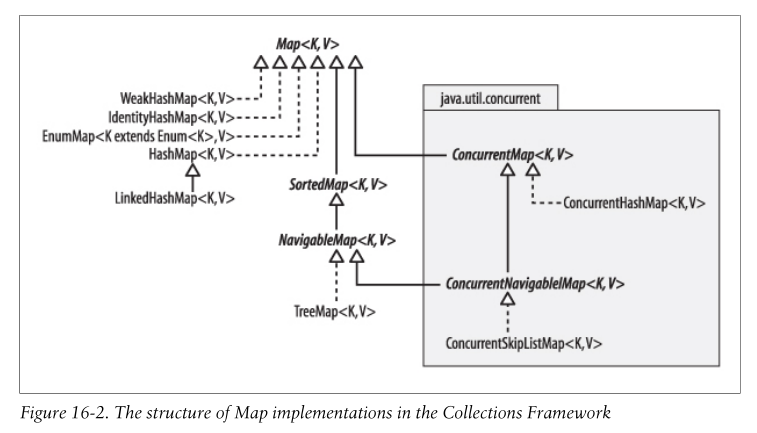
the_structure_of_map_implementation.png

HashMap

hashmap构造
1
2
public HashMap(int initialCapacity)
public HashMap(int initialCapacity, float loadFactor)

容量确定
默认16
HashMap的bucket 数组大小一定是2的幂,若不是,寻找最近的的2的幂
该算法让最高位的1后面的位全变为1

1
2
3
4
5
6
7
8
9
10
11
12
//|=:n与后面的数做或运算
//>>>:无符号右移
static final int tableSizeFor(int cap) {   
int n = cap - 1;   
n |= n >>> 1;   
n |= n >>> 2;   
n |= n >>> 4;   
n |= n >>> 8;   
n |= n >>> 16;   
return (n < 0) ? 1 : (n >= MAXIMUM_CAPACITY) ? MAXIMUM_CAPACITY : n
+ 1;
}

loadFactor加载因子
默认0.75f
loadFactor加载因子是控制数组存放数据的疏密程度(01,稀疏密集)
冲突数<6转链表,>=8转红黑树(因为泊松分布)

put过程

put过程:(1.8)
1、 如果定位到的数组位置没有元素 就直接插入。
2、如果定位到的数组位置有元素就和要插入的key比较,如果key相同就直接覆盖,如果key不相同,就判断p是否是一个树节点,如果是就调用e = ((TreeNode<K,V>)p).putTreeVal(this, tab, hash, key, value)将元素添加进入。如果不是就遍历链表插入(插入的是链表尾部)。
put过程:(1.7)
1、如果定位到的数组位置没有元素 就直接插入。
2、如果定位到的数组位置有元素,遍历以这个元素为头结点的链表,依次和插入的key比较,如果key相同就直接覆盖,不同就采用头插法插入元素。

resize过程

resize
1.7:
初始化一个大小为(capacity x 2)的新数组,将原数组在hash至新数组中。
链表元素会倒置
1.8:
桶中存在一个链表,需要将链表重新整理到新表当中,因为((newCap = oldCap << 1)所以原节点的索引值要么和原来一样,要么就是原(索引+oldCap)和JDK 1.7中实现不同这里不存在rehash

迭代器

迭代器快速失效

LinkedHashMap

构造
1
2
3
public LinkedHashMap(int initialCapacity,
float loadFactor,
boolean accessOrder)

Hashmap实体中添加before,after(双向链表)实现有序访问
LinkedHashMap添加head、tail(头指针和尾指针)
protected boolean removeEldestEntry(Map.Entry<K,V> eldest)
accessOrder
accessOrder: 为 false按插入顺序访问;为true,按访问顺序访问(LRU算法)

LRU实现
1
protected boolean removeEldestEntry(Map.Entry<K,V> eldest)

可以重载该方法自己定义策略

是否线程安全

不安全,迭代器快速失效

WeakHashMap

用途
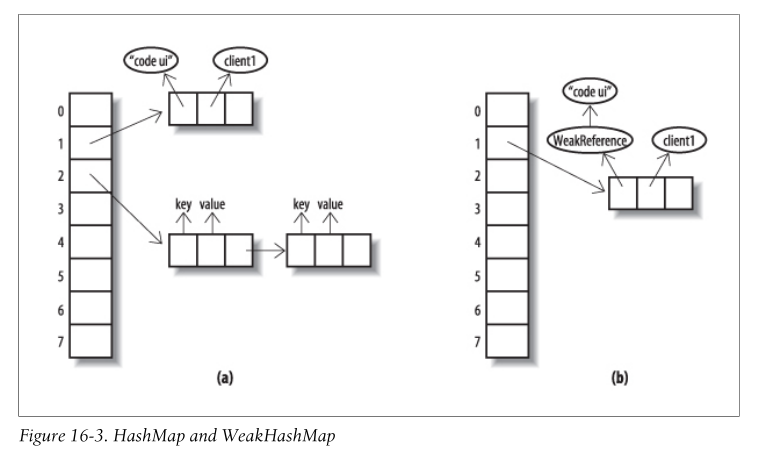
  • 客户端连接服务器保存的一些信息
  • 缓存信息
    hashmap与weakhashmap对比
    hashmap_and_weakhashmap.png
回收原理

gc判断是否为弱引用(有没被其他代码使用)若是回收key,将value放入referencequeue
weakhashmap会在下一次调用expungeStaleEntries方法时回收value;

是否线程安全

不安全,迭代器快速失效

IdentityHashMap

用途

序列化
深度复制
记录对象代理
记录jvm对象

构造函数
1
2
3
public IdentityHashMap()
public IdentityHashMap(Map<? extends K,? extends V> m)
public IdentityHashMap(int expectedMaxSize)

默认大小32
默认加载因子为0.67

1
2
3
4
5
private static int capacity(int expectedMaxSize) {    
// assert expectedMaxSize >= 0;   
return       
(expectedMaxSize > MAXIMUM_CAPACITY / 3) ? MAXIMUM_CAPACITY :        (expectedMaxSize <= 2 * MINIMUM_CAPACITY / 3) ? MINIMUM_CAPACITY
:        Integer.highestOneBit(expectedMaxSize + (expectedMaxSize << 1));}

初始化一个数组(大小为给定值转为最接近2的幂的值且大于等于给定数 * 2)

处理hash冲突

使用线性探针法,如下图:
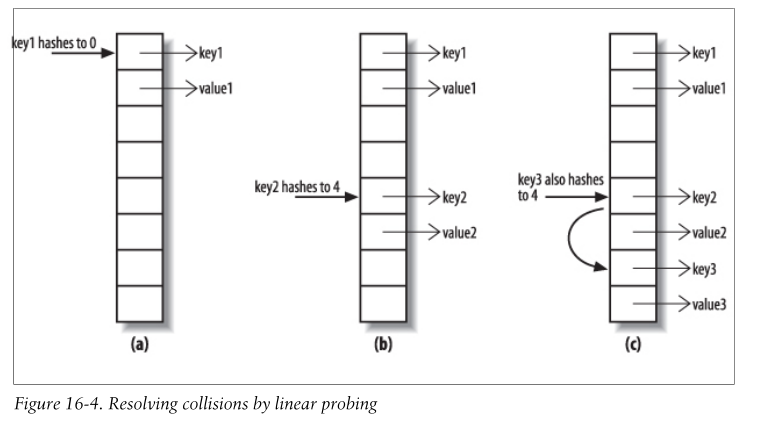
resolving_collision_by_linear_probing.png

判定相等

与hashmap不同
identityhashmap是判断key1和key2的地址是否相等的(key1==key2)

扩容

元素达到阈值时,会进行扩容处理,扩容后会旧表中的元素重新hash到新表中

删除元素

在删除一个元素后会进行一次closeDeletion处理,重新分配元素的位置

EnumMap

EnumMap代替叙述索引
key不能为null,value可以

SortedMap和NavigableMap

SortedMap接口

sortedmap接口已经被navigablemap接口替代(与sortedset和mavigableset类似)

获取第一个元素和最后一个元素
1
2
K firstKey()
K lastKey()

若无元素,返回 NoSuchElementException

获取比较器
1
Comparator<? super K> comparator()
查看子元素
1
2
3
SortedMap<K,V> subMap(K fromKey, K toKey)
SortedMap<K,V> headMap(K toKey)
SortedMap<K,V> tailMap(K fromKey)

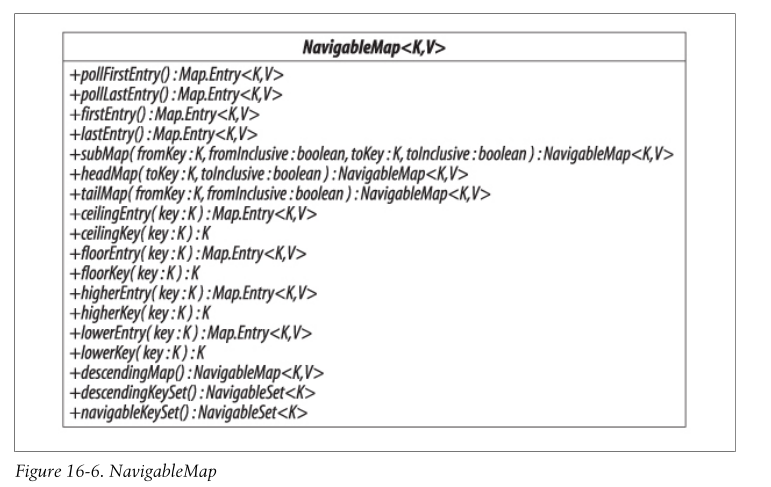
navigablemap.png

获取第一个元素和最后一个元素
1
2
3
4
Map.Entry<K,V> pollFirstEntry()
Map.Entry<K,V> pollLastEntry()
Map.Entry<K,V> firstEntry()
Map.Entry<K,V> lastEntry()
获取范围视图
1
2
3
4
NavigableMap<K,V> subMap(
K fromKey, boolean fromInclusive, K toKey, boolean toInclusive)
NavigableMap<K,V> headMap(K toKey, boolean inclusive)
NavigableMap<K,V> tailMap(K fromKey, boolean inclusive)

可以选择是否包括上界和下界

获取最近比配的数据
1
2
3
4
5
6
7
8
Map.Entry<K,V> ceilingEntry(K Key)
K ceilingKey(K Key)
Map.Entry<K,V> floorEntry(K Key)
K floorKey(K Key)
Map.Entry<K,V> higherEntry(K Key)
K higherKey(K Key)
Map.Entry<K,V> lowerEntry(K Key)
K lowerKey(K Key)
1
2
3
NavigableMap<K,V> descendingMap() // return a reverse-order view of the map
NavigableSet<K> descendingKeySet() // return a reverse-order key set
NavigableSet<K> navigableKeySet() // return a forward-order key set

TreeMap

构造

除了空构造和通过map构造,treemap还提供了一下两种构造函数

1
2
public TreeMap(Comparator<? super K> comparator)
public TreeMap(SortedMap<K, ? extends V> m)
其他特性

get ,put和 remove操作花费O(log n) 时间复杂度
迭代器快速失效

ConcurrentMap接口

为高并发场景下的Map提供原子操作

1
2
3
4
5
6
7
8
9
10
11
12
13
14
V putIfAbsent(K key, V value)
// associate key with value only if key is not currently present.
// return the old value (may be null) if the key was present,
// otherwise return null
boolean remove(Object key, Object value)
// remove key only if it is currently mapped to value. Returns
// true if the value was removed, false otherwise
V replace(K key, V value)
// replace entry for key only if it is currently present. Return
// the old value (may be null) if the key was present, otherwise
// return null
boolean replace(K key, V oldValue, V newValue)
// replace entry for key only if it is currently mapped to oldValue.
// return true if the value was replaced, false otherwise

ConcurrentHashMap

实现原理

1.7
采用乐观读+分段锁实现 来 实现ConcurrentMap
ConcurrentHashMap 是由 Segment 数组结构和 HashEntry 数组结构组成
Segment 实现了 ReentrantLock
1.8
采用CAS和synchronized来保证并发安全。数据结构跟HashMap1.8的结构类似,数组+链表/红黑二叉树。synchronized只锁定当前链表或红黑二叉树的首节点,这样只要hash不冲突,就不会产生并发,效率又提升N倍

其他

默认容量16
在获取size()会导致全锁,开销大
构造函数提供并发级别控制

1
2
3
4
5
6
ConcurrentHashMap()
ConcurrentHashMap(int initialCapacity)
ConcurrentHashMap(int initialCapacity, float loadFactor)
ConcurrentHashMap(
int initialCapacity, float loadFactor, int concurrencyLevel)
ConcurrentHashMap(Map<? extends K,? extends V> m)

ConcurrentNavigableMap

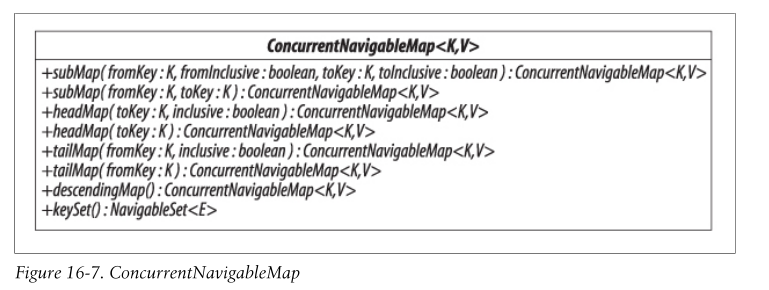
concurrentnavigablemap.png

ConcurrentSkipListMap

是concurrentskiplistset的底层实现get , put , and remove 花费O(log n) 时间
迭代器快速失效

Map实现的对比
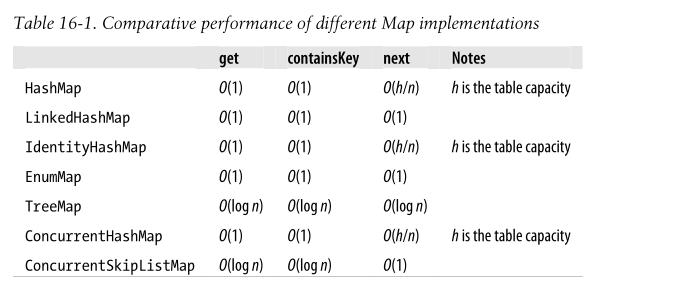
comparative.png

0%